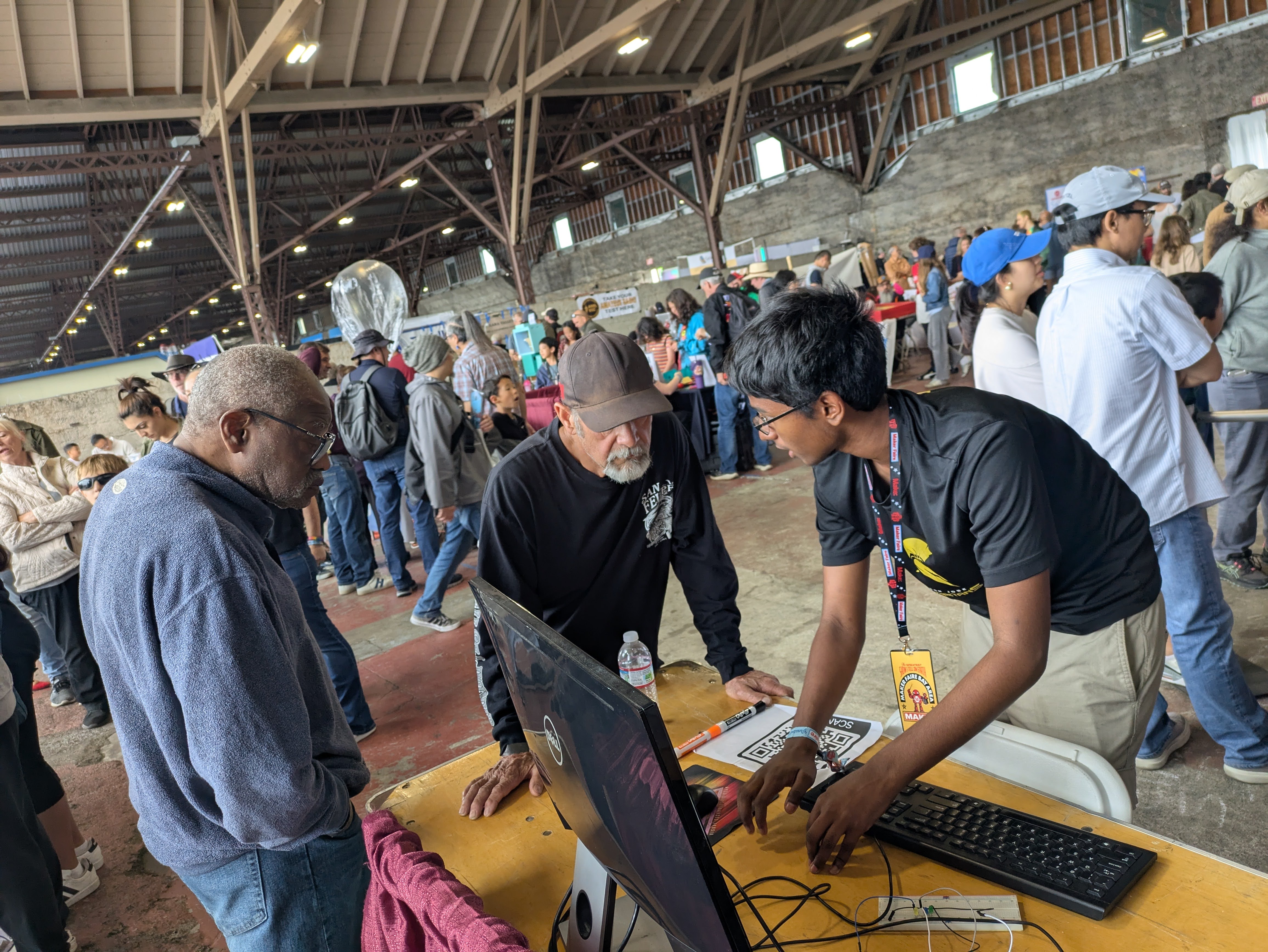
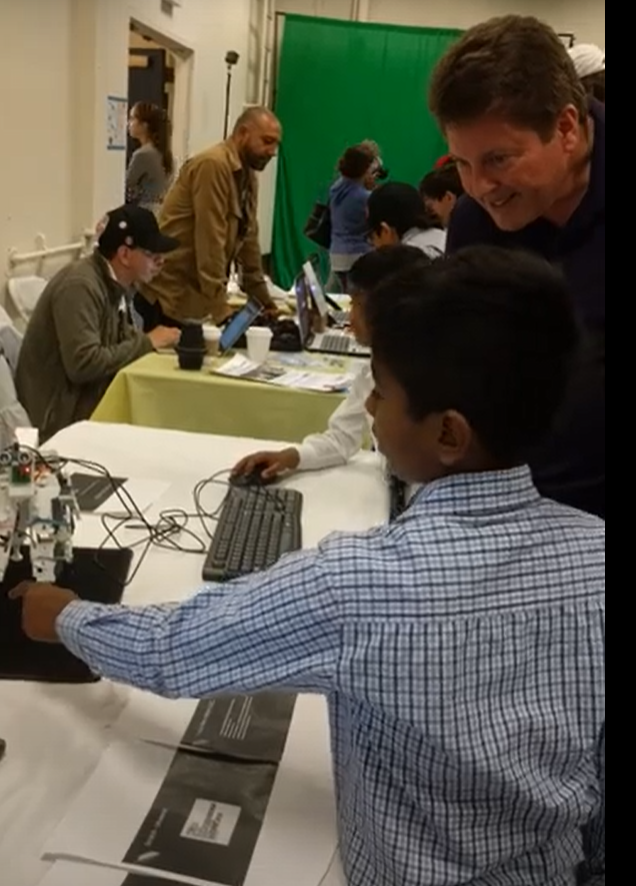
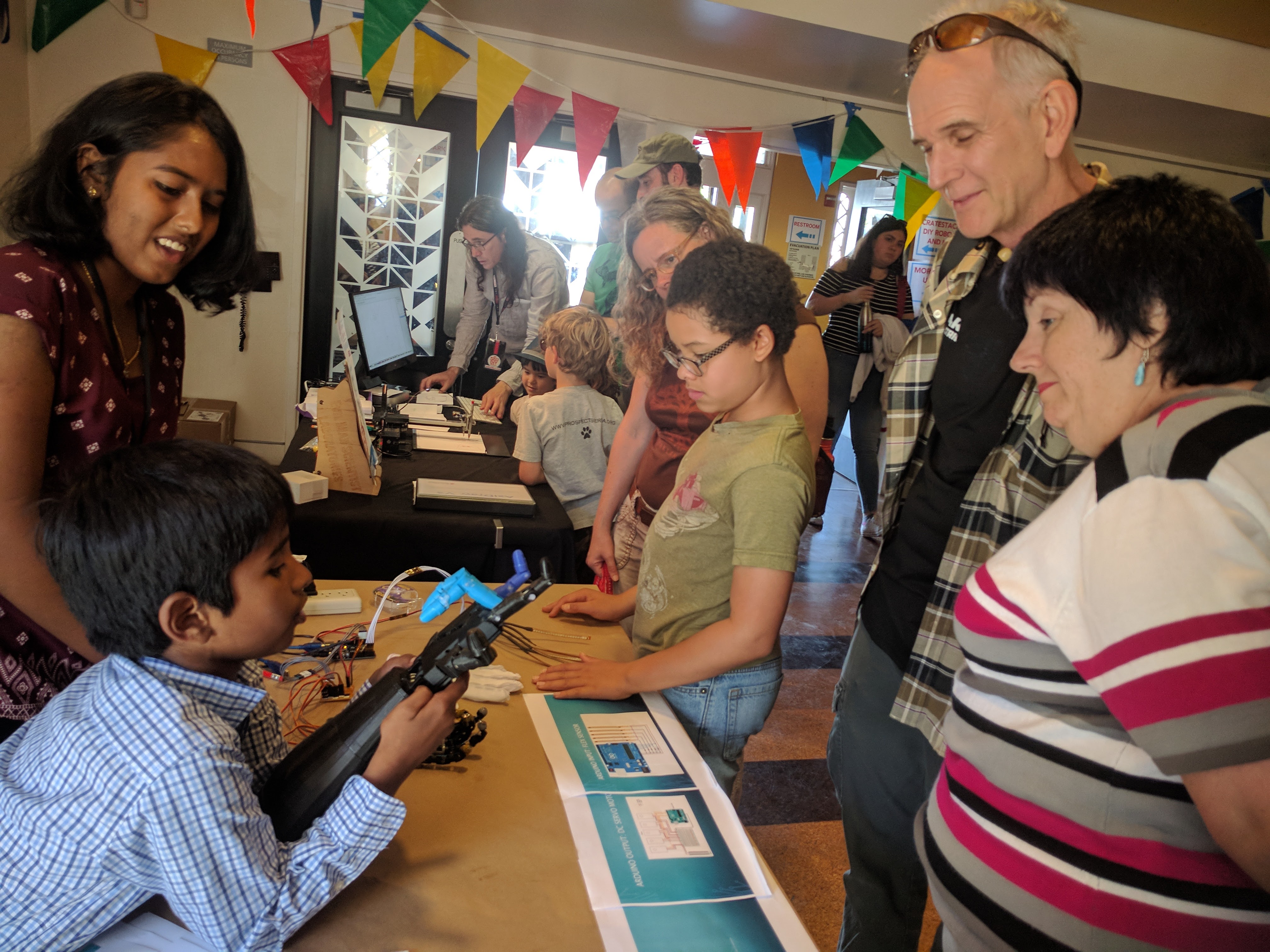
Showcasing student creativity and innovation through hands-on projects and community exhibitions
Our Maker Faire Journey
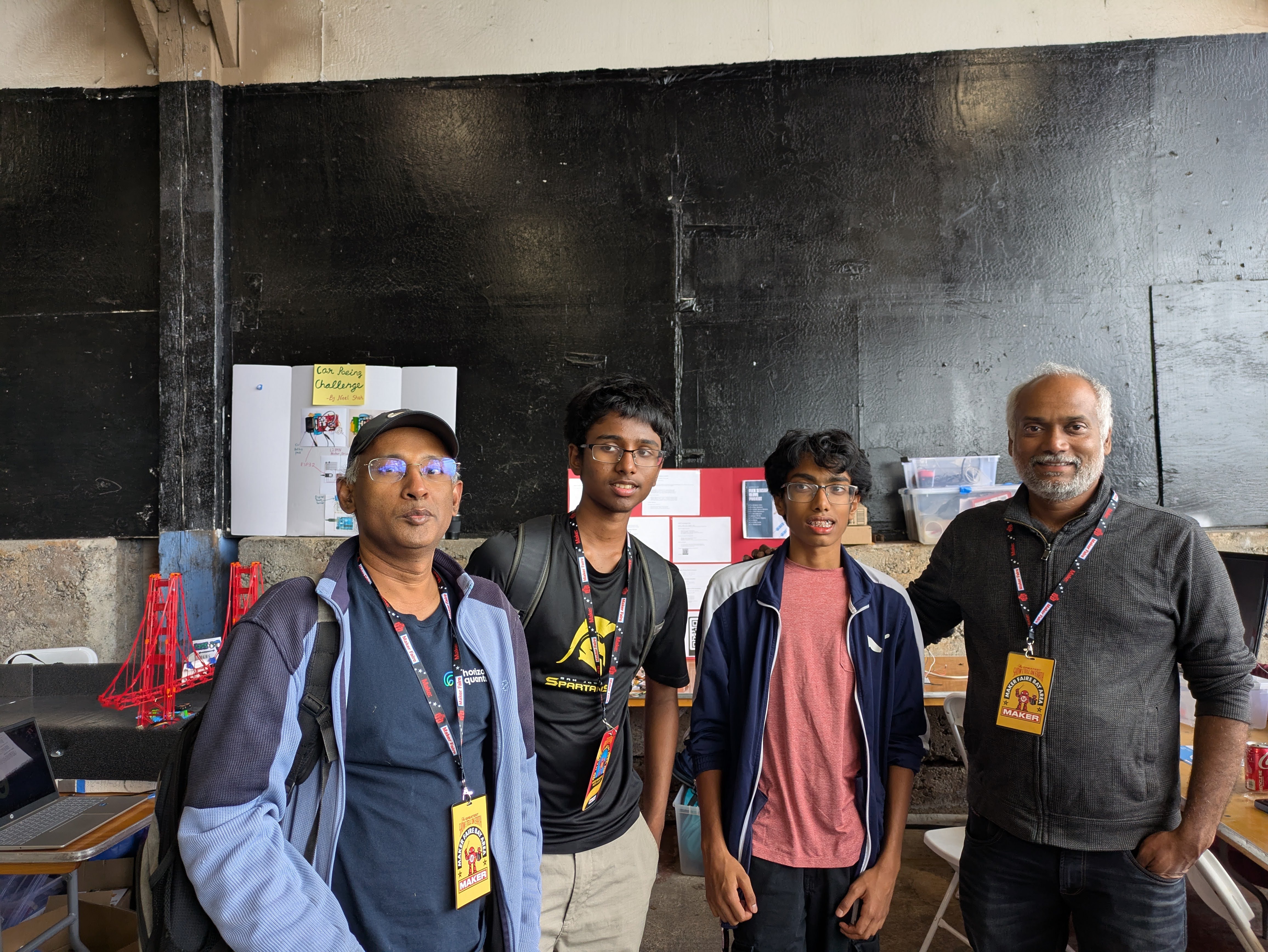
AOST helps curiosity-driven kids select and complete projects for Maker Faire. We believe in learning by doing - pick a problem, learn the skills, build it, and exhibit your creation to inspire others.
Community Event
Open to families and the community to see student innovations
Student Showcases
Students present their projects and explain their learning journey
Interactive Learning
Visitors can try activities and learn alongside our students
Maker Faire Bay Area 2026 (This Year)
September 25–27, 2026 · Category: Artificial Intelligence
This year's exhibit
Fly Eye, Worm Brain: A Car That Drives on Borrowed Biology
A simulated 1/10-scale car follows a taped line using two pieces borrowed from animals: a fly's eye for seeing and a worm's 19-neuron circuit for steering. The question was never “can it drive?” — plenty of things drive. It was which borrowed part actually earns its keep, tested by removing each one and measuring what breaks.
0.0 vs 13.0departures/min under a hard shadow: fly eye vs raw pixels
80 Hzsimulation rate, real network driving live in the browser
How it works
Camera64×48 greyscale
Fly eyecontrast + motion
Small conv net32 features
Worm circuit19 neurons
Steering±1
The fly's eye — fixed arithmetic, nothing learned
Contrast channel compares each point to its surroundings (Weber contrast) instead of reading absolute brightness, so it is unaffected by the overall light level. This is what finds the line.
Motion channel uses Hassenstein–Reichardt correlators[1]: one photoreceptor's delayed signal times its neighbour's current one. It cannot find the line; it reports how the car itself is moving, pooled into four numbers — turn rate, the line's motion, speed and ground rush.
The worm's circuit — small on purpose
Wiring copied from the C. elegans tap-withdrawal reflex[2], built as a Neural Circuit Policy[3] with closed-form continuous-time (CfC) neurons[4].
12 inter, 6 command and 1 motor neuron; 60 recurrent and 144 sensory connections — not all-to-all. Only 2,216 learned numbers.
One motor neuron means steering only: the worm steers, a simple hand-written rule works the pedal.
Training: first the network imitates a pure-pursuit driver[5] on unbroken 64-step sequences (never shuffled frames, because the circuit has memory), then it is fine-tuned with reinforcement learning (PPO[6]), which adds a learned throttle while the 19 neurons keep steering.
The experiment: take each part away
Driver
Fly eye
Worm circuit
Answers
Full system
yes
yes
the baseline
No-memory reflex
yes
no (plain MLP)
does the wiring matter?
Plain camera
no (raw pixels)
yes
does the eye matter?
Each comparison uses an identical conv stack and identical wiring, so these are true ablations rather than three unrelated models.
What we found
1. The fly eye ignores shadows
16 car-minutes per lighting condition (16 cars × 20 s × 3 seeds). Each cell: departures per car-minute · mean distance off the line.
Lighting
Fly eye
Raw pixels
Even
0.0 · 2.14 cm
0.0 · 2.15 cm
Whole-room flicker
0.0 · 2.24 cm
0.0 · 2.22 cm
Brightness gradient
0.0 · 2.31 cm
0.0 · 2.45 cm
Lamp on the floor
0.0 · 2.27 cm
0.5 · 3.34 cm
Hard shadow edge
0.0 · 2.39 cm
13.0 · 3.31 cm
Slatted blinds
16.2 · 3.46 cm
12.4 · 4.09 cm
Whole-room flicker is a tie — the control that proves the failure comes from uneven light, not dim light. And we kept the honest limitation: under slatted blinds the moving stripes fool the motion detectors into “seeing” the car turn, so the fly eye does worse than raw pixels.
2. The worm circuit: an honest null result on the tabletop
On the tabletop track the memoryless reflex network matched or beat the 19-neuron circuit in every condition tested (2.1 vs 2.2 cm in even light). Switching single neurons off showed the circuit is highly redundant: 17 of 19 neurons are individually expendable — only command neuron C6 and the motor neuron M are vital. Steering turned out to be a tug-of-war: most neurons pull one way all the time, and the steering is the balance between them.
3. On a full-size simulated car, both borrowed parts helped
The same tabletop weights, with no retraining, drove a full-size car in the CARLA simulator[7] (Town10HD, 300 s per driver, one run each):
Fly eye + worm circuit
3.0 cm
Fly eye + no-memory net
5.6 cm
Raw pixels + worm circuit
9.3 cm
On a toy car the fancy wiring didn't help; on a full-size one it did — and we don't yet know why. These are single runs, so we report both results side by side rather than averaging them into one happy claim. In CARLA the car is shown a simplified drawing of where the line is, computed from its own position; the car, physics and road are genuine, but it does not look at the photoreal city.
4. The “gaps in the line” test
If the worm's memory matters, it should coast through places where the tape is missing. We lifted stretches of tape (four per lap, 30–60 cm) and compared the circuit with the no-memory control for 2 minutes per setting. Result: both cross 10–20 cm gaps cleanly, and neither has a consistent advantage on longer gaps. Only imitation-trained brains were tested — a circuit trained with gaps might behave differently, which is next on our list.
At the booth
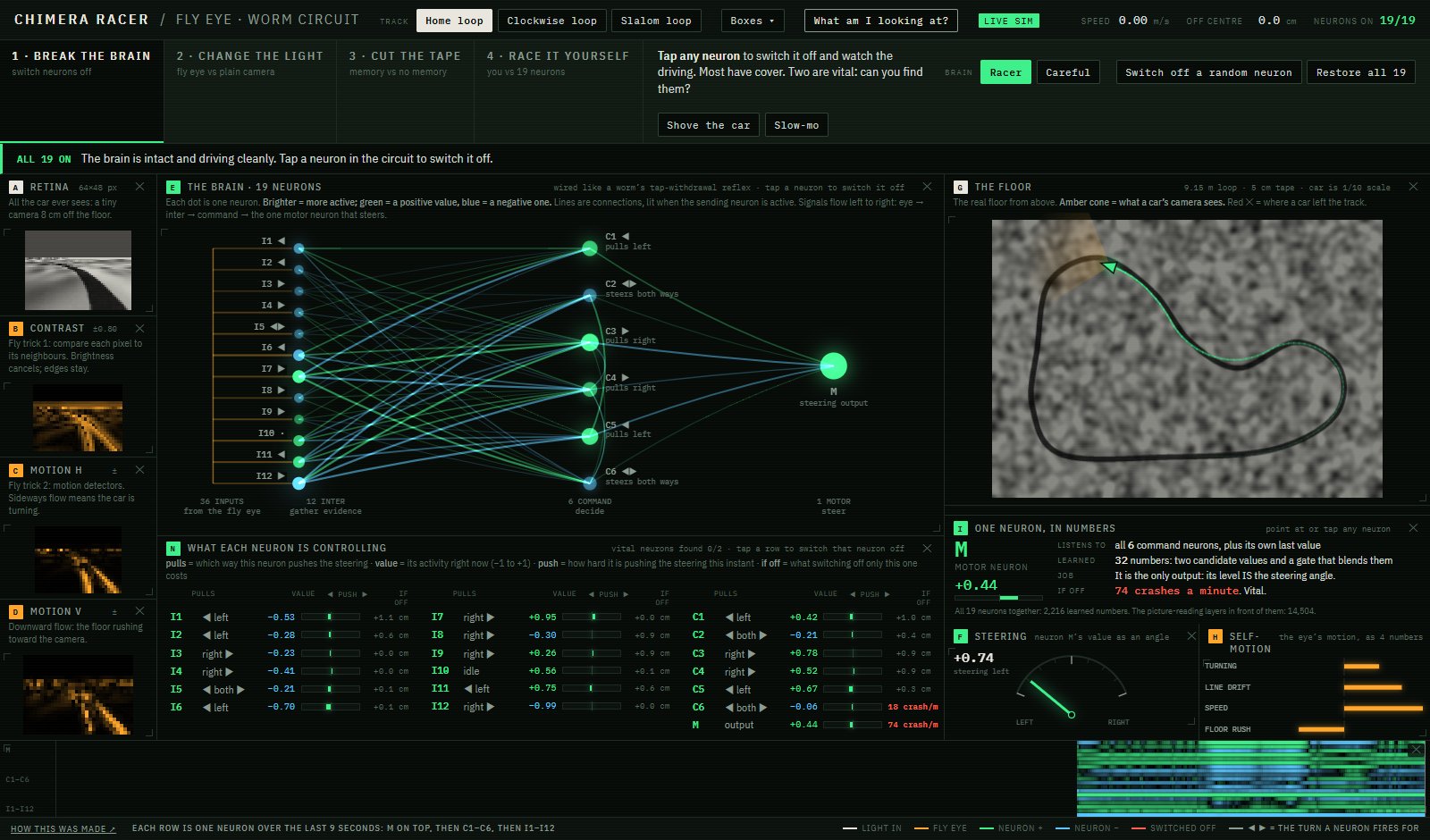
Nothing on our screens was a recording. The real trained network drove a real simulator, live, 80 steps a second, so visitors could experiment for themselves:
Break the brainTap any neuron to silence it and watch what the steering does.
Change the lightFly eye vs plain camera, side by side, under five lighting conditions.
Cut the tapeLift stretches of tape and see whether memory helps.
Race it yourselfSteer a car with the arrow keys against the 19-neuron brain.
The live simulator: what the camera sees, the fly eye's contrast and motion channels, all 19 neurons firing, and the car on the track — running in real time.
Want to try our live simulator?
Silence neurons, change the lighting, cut the tape or race the 19-neuron brain yourself. Reach out and we'll share access with you.
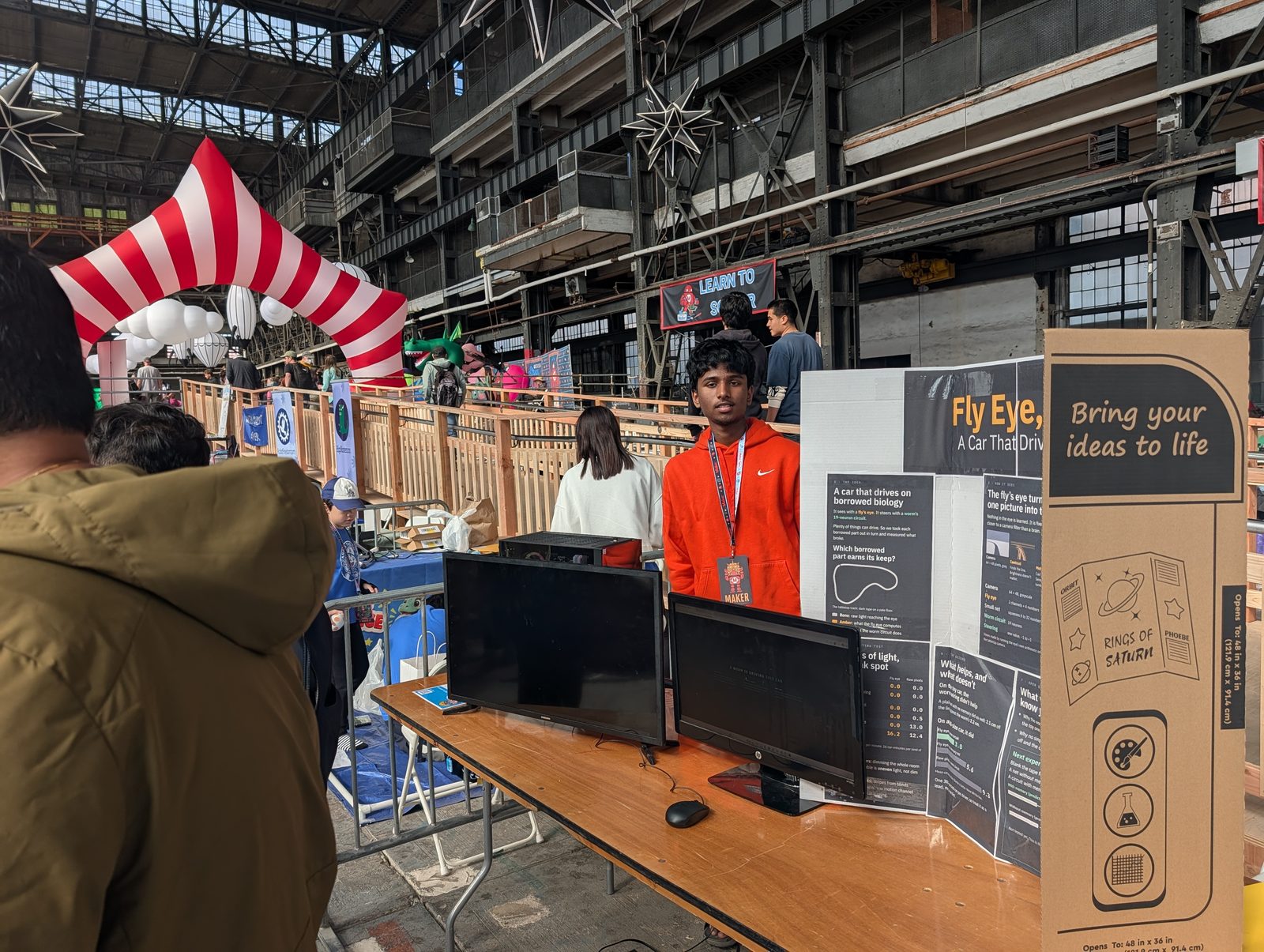
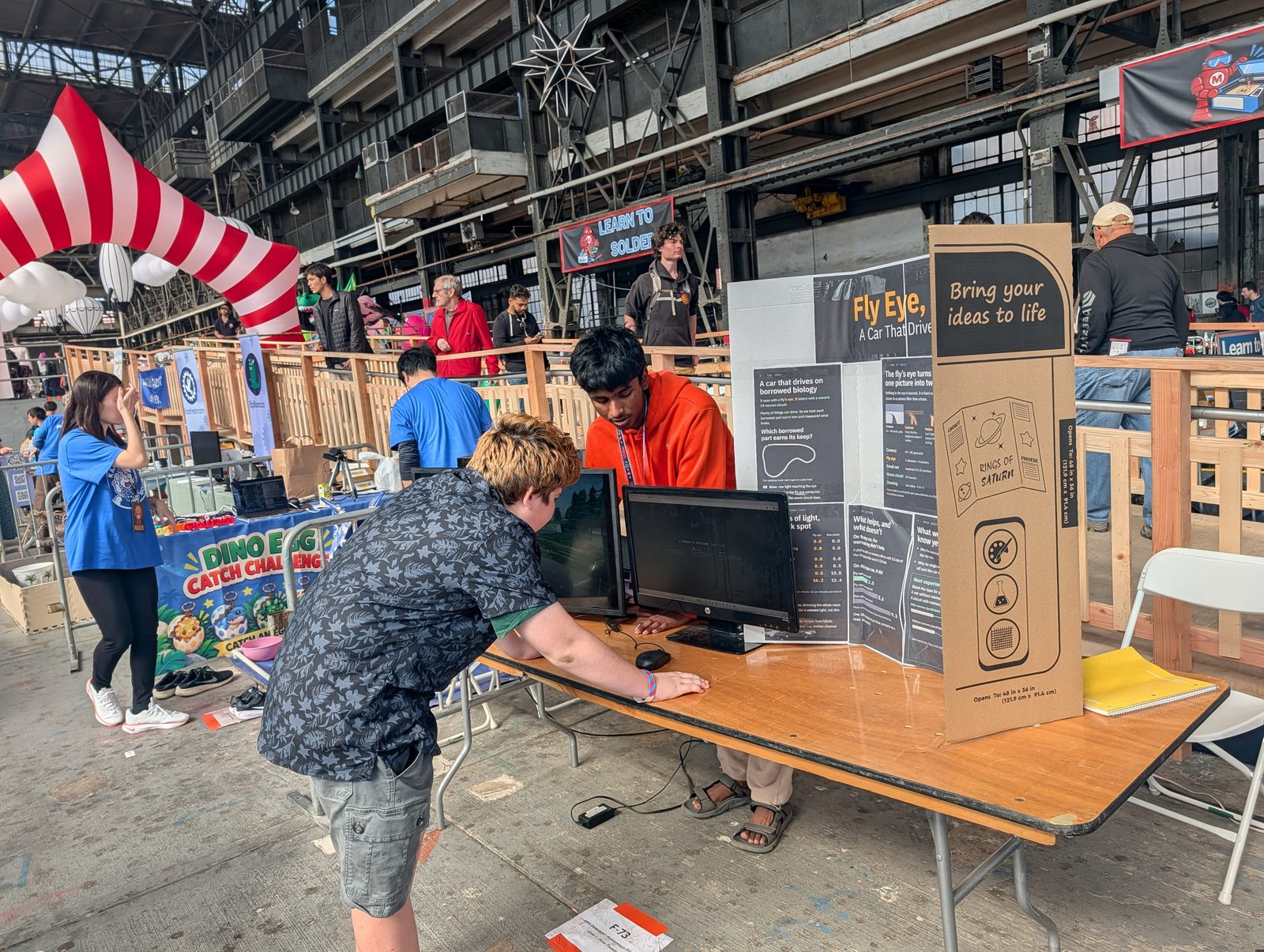
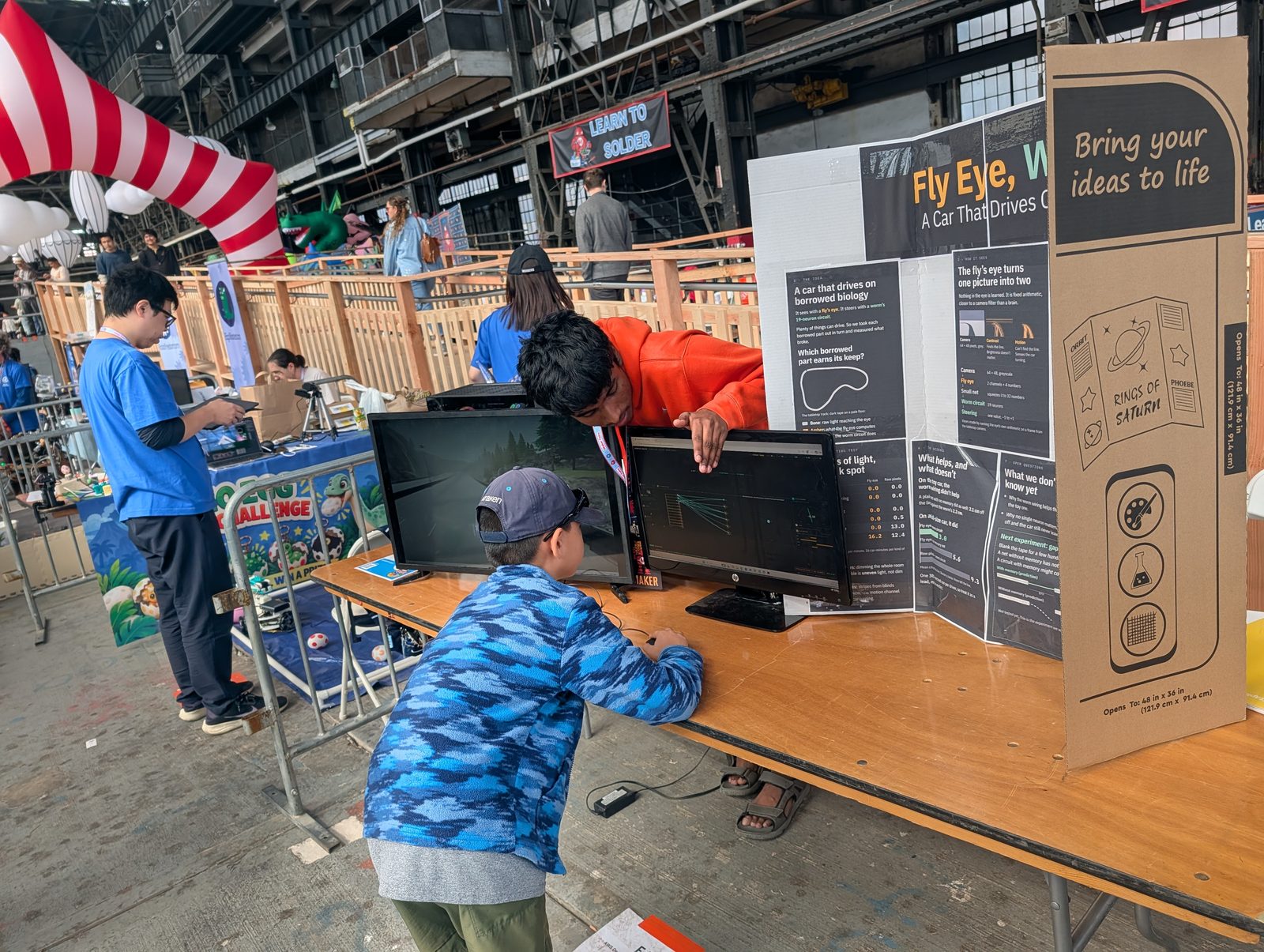
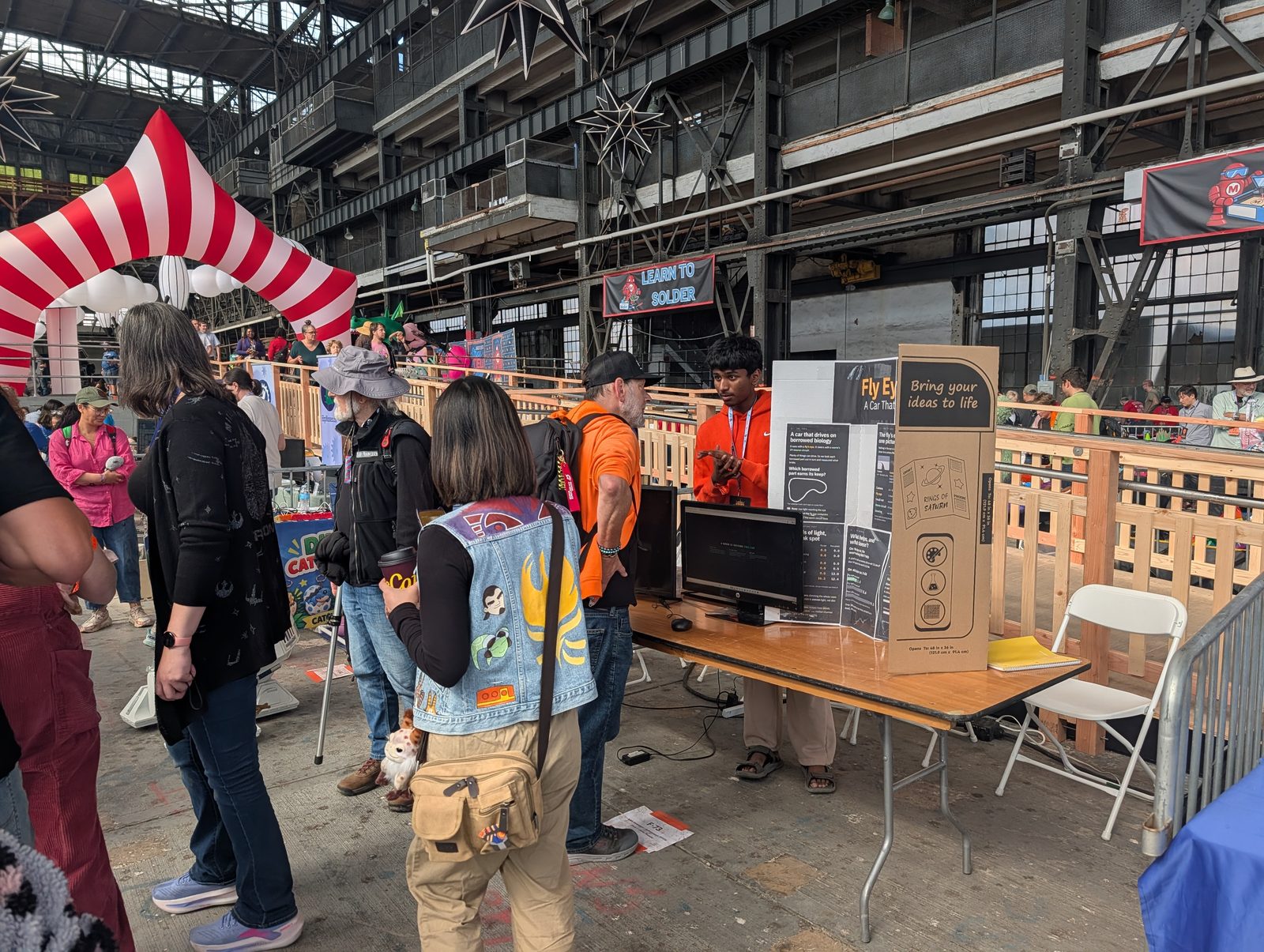
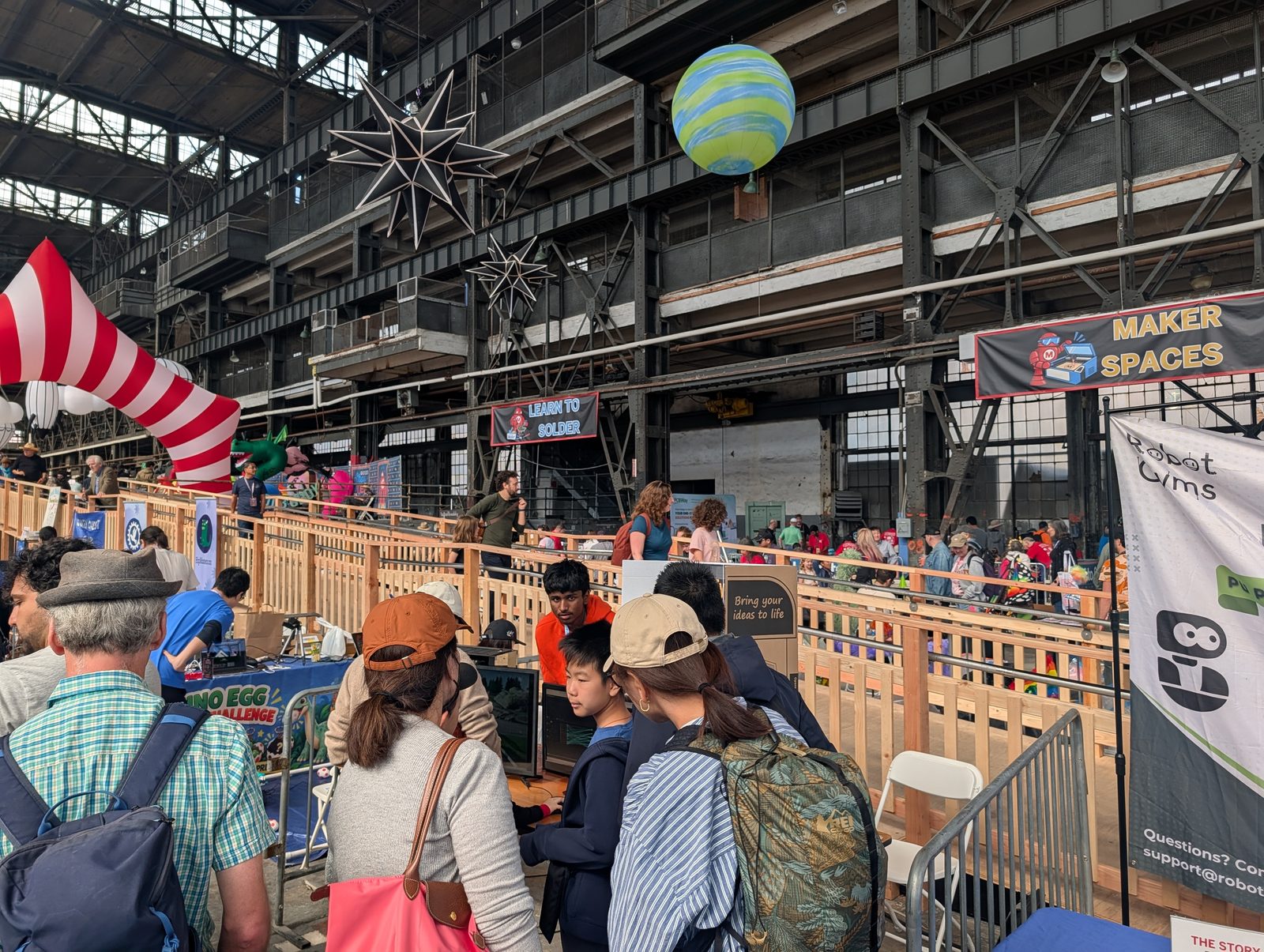
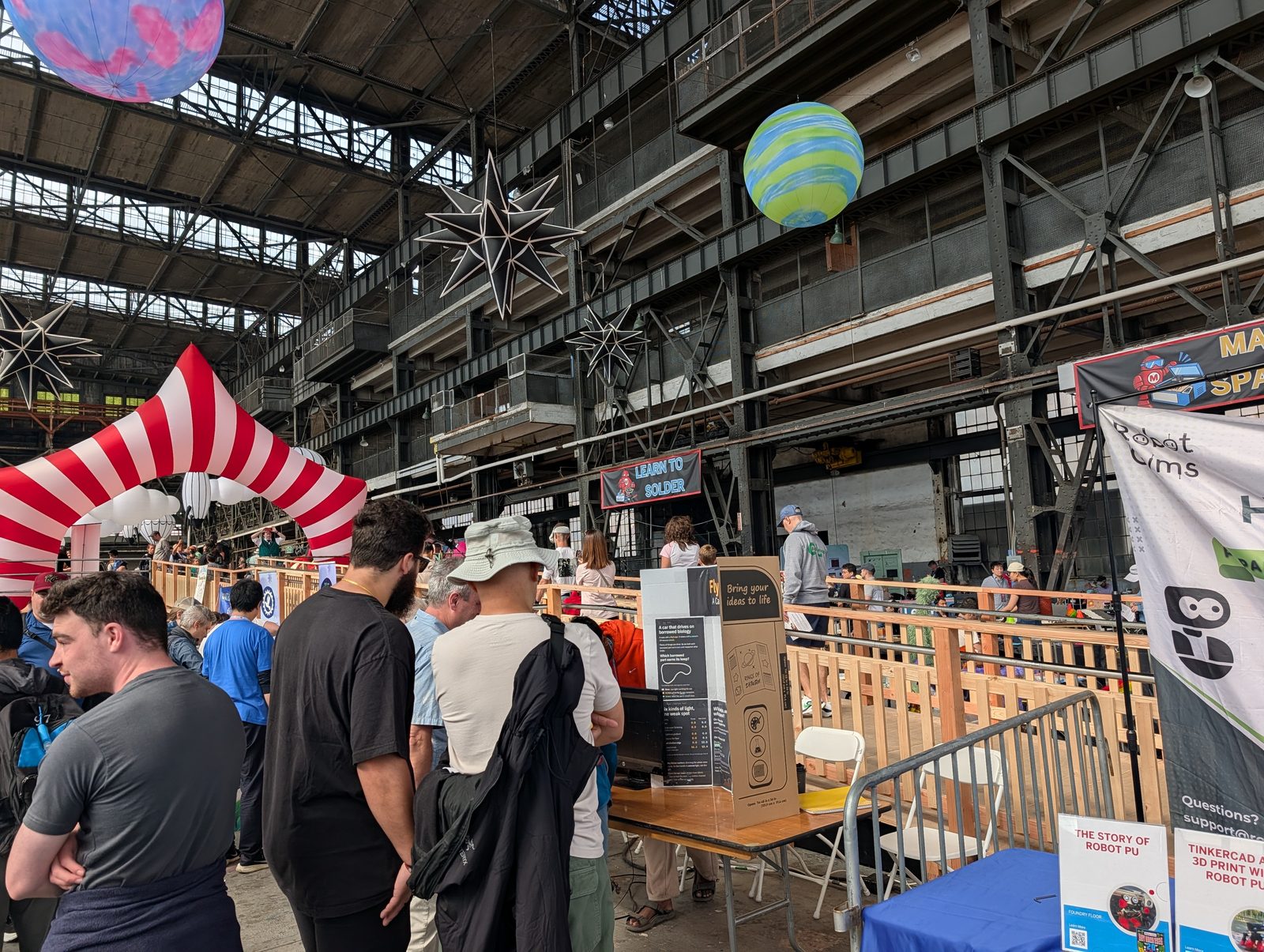
A visitor takes the wheelExploring the 19-neuron displayExplaining the fly eye to visitorsA busy afternoon in the Maker Spaces hallVisitors lining up to try itBooth set-up: poster and live screens
References
B. Hassenstein and W. Reichardt, “Systemtheoretische Analyse der Zeit-, Reihenfolgen- und Vorzeichenauswertung bei der Bewegungsperzeption des Rüsselkäfers Chlorophanus,” Zeitschrift für Naturforschung B, vol. 11, pp. 513–524, 1956.
S. R. Wicks, C. J. Roehrig and C. H. Rankin, “A dynamic network simulation of the nematode tap withdrawal circuit: predictions concerning synaptic function using behavioral criteria,” Journal of Neuroscience, vol. 16, no. 12, pp. 4017–4031, 1996.
M. Lechner, R. Hasani, A. Amini, T. A. Henzinger, D. Rus and R. Grosu, “Neural circuit policies enabling auditable autonomy,” Nature Machine Intelligence, vol. 2, pp. 642–652, 2020.
R. Hasani, M. Lechner, A. Amini, L. Liebenwein, A. Ray, M. Tschaikowski, G. Teschl and D. Rus, “Closed-form continuous-time neural networks,” Nature Machine Intelligence, vol. 4, pp. 992–1003, 2022.
R. C. Coulter, “Implementation of the Pure Pursuit Path Tracking Algorithm,” Carnegie Mellon University Robotics Institute, Tech. Rep. CMU-RI-TR-92-01, 1992.
J. Schulman, F. Wolski, P. Dhariwal, A. Radford and O. Klimov, “Proximal Policy Optimization Algorithms,” arXiv:1707.06347, 2017.
A. Dosovitskiy, G. Ros, F. Codevilla, A. Lopez and V. Koltun, “CARLA: An Open Urban Driving Simulator,” in Proc. Conference on Robot Learning (CoRL), 2017.